
Why Your 120°C Magnets Fail at 100°C?
A common question from customers is why their 120°C-rated magnets experience magnetic strength loss when used at 100℃. Do manufacturers misrepresent the specifications? No. In fact, the invisible killer is high-temperature demagnetization. This article will reveal the truth about temperature resistance of neodymium magnets.
1. What’s the Relationship Between Magnet Grade and Temperature Resistance?
NdFeB magnet grades are usually composed of “numbers + letters,” such as N35SH. The number represents the strength of the magnetic force, while the second letter (or none) indicates its temperature resistance. Below is a grade comparison table for your reference:
| Grade | Max. Operating Temp(Recommended Value) | Core Characteristics | Applications |
| N | ≤ 80 | Highest cost-performance ratio, heat sensitive | Toys; Packaging boxes; General adsorption |
| M | ≤ 100 | Basic temperature resistant | General motors; Speakers |
| H | ≤ 120 | Industrial entry-level | Servo motors; Industrial pumps |
| SH | ≤ 150 | High-performance standard | Power tools; Automotive micro motors |
| UH | ≤ 180 | Extremely stable | Main drive motors for new energy vehicles |
| EH | ≤ 200 | Dedicated to extreme environments | Magnetic drives; High-temperature motors |
| AH | ≤ 220 | The “ceiling” of magnetic materials | Aerospace; Special sensors |
Note: When choosing magnets, don’t focus solely on the maximum operating temperature. Higher grades contain more heavy rare earth elements (dysprosium, terbium), which increases the price. Therefore, choose the most suitable magnet, not the most expensive one.
2. What is the Maximum Operating Temperature and the Curie Temperature?
We often receive customer inquires regarding, “My magnet is labeled as heat-resistant up to 200°C, so why does its magnetic strength weaken when I test it at 180°C?” Here, it is important to clarify two completely different concepts:
- Maximum Operating Temperature:
This refers to the temperature at which the magnetic force temporarily decreases. Most of the force can recover after cooling. However, if it exceeds this temperature, the magnet will experience irreversible loss. In other words, even after cooling, its magnetic force cannot return to the original level.
- Curie Temperature:
This usually ranges between 310°C and 350°C. You can think of it as the complete magnetic failure temperature. Once reaching this temperature, the internal magnetic domain structure of the magnet completely breaks down. It will become ordinary scrap metal.
Therefore, remember that the Curie temperature is the “finish line,” while the maximum operating temperature is the “red line.” When designing solutions, please ensure that the temperature resistance of the magnet is at least 20°C above the red line.

3. How does Thickness Affect the Temperature Resistance of a Magnet?
This is a crucial piece of information rarely mentioned in existing articles – the thickness of the magnet affects its temperature resistance.
In professional terms, this is called the permeance coefficient (PC value). Simply put, if a magnet is designed in the shape of a thick brick, its “resistance” will be high, and it will be able to withstand its specified temperature range. If the magnet is designed like a thin pancake, its “resistance” will decrease significantly.
For example, both are 38SH grade (max. operating temperature 150℃).
• A 10mm thick block magnet may perform well at 150℃.
• A 1mm thick magnet may begin to demagnetize rapidly at 120℃.
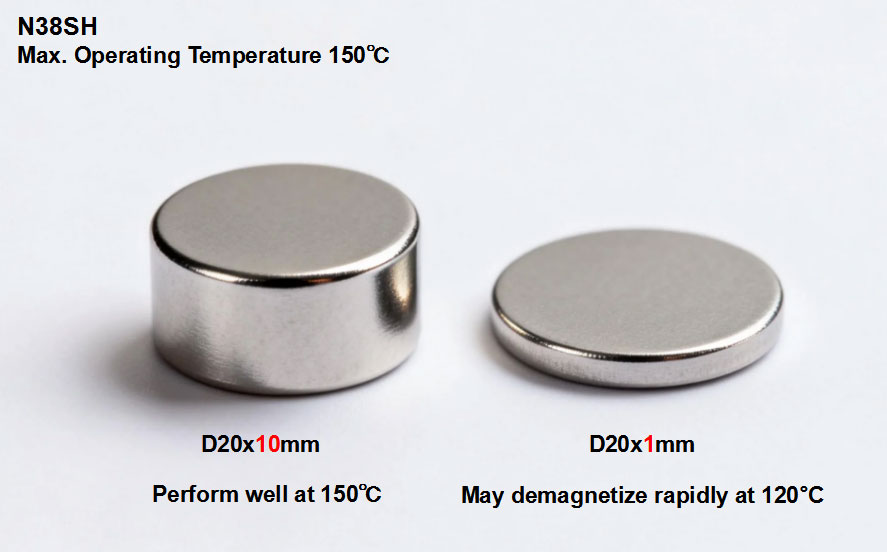
Therefore, when requesting a quotation, don’t just ask “what price of the magnet?” Be sure to tell the supplier the specific dimensions and operating temperature of magnets you need.
4. How do Heavy Rare Earth Affect the Temperature Resistance of Magnets?
Neodymium magnets are highly sensitive to high temperatures. As the temperature rises, the “magnetic domains” within magnets begin to move randomly. Therefore, manufacturers will add certain rare earth elements such as dysprosium (Dy) or terbium (Tb) during production to enhance the temperature resistance of neodymium magnets. These heavy rare earth elements act as a “strong adhesive” significantly increasing the intrinsic coercivity (Hcj) of the magnets.
The higher the content of heavy rare earth elements, the greater the coercivity of the magnets, as well as their resistance to demagnetization in high temperature. But this also results in a higher cost for magnets.
Previously, to achieve high temperature resistance, expensive heavy rare earth elements were mixed throughout the entire magnet. Now, advanced technology uses an “external application method” – Grain Boundary Diffusion (GBD), allowing the heavy rare earth to penetrate into the gaps of the magnet. GBD technology enables higher temperature resistance to be achieved at a lower cost. If your supplier mentions GBD technology, it indicates they have a mainstream cost-reduction solution.
5. How to Prevent High-Temperature Demagnetization?
To ensure your motor doesn’t fail, it’s recommended to request the following three “health reports” from your supplier before making a bulk purchase:
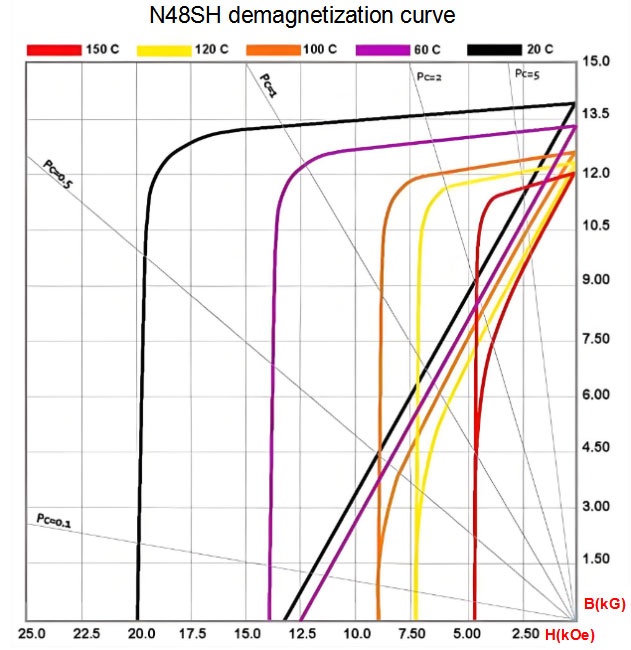
- Demagnetization Curve
This assesses the ability of the magnet to retain magnetic force at different temperatures. Pay attention to the smoothness of the curve and the inflection point. The inflection point indicates that the magnet will experience severe and irreversible demagnetization near that temperature. This is the key basis for determining the maximum operating temperature of the magnet.
- Thermal Stability Test
This is a type of aging test that simulates long-term use. Place the magnet at a specific high temperature (such as its operating temperature) for periods of 2 hours, 100 hours, or even 1000 hours. The test aims to simulate the degradation of its performance in real-world conditions. The result of this test is the percentage of magnetic force loss. This value provides a direct indication of the stability and reliability of the magnet during long-term operation at high temperatures.
- PCT/HAST Tests
These tests are used to evaluate the durability of magnets in harsh environments. Place the magnet under high temperatures and pressures. The purpose is to determine whether they are prone to issues such as surface oxidation, coating peeling, or internal structural delamination. Such problems can directly lead to the failure of the magnets.
6. How to Choose Suitable High-temperature Resistant Magnet?
1. Confirm the Working Environment: Measure the actual operating temperature inside the motor housing, remembering to add a 15%-20% safety margin.
2. Consider the Shape: For thinner magnets, choose a grade with a higher temperature resistance. For example, if M grade is sufficient, choose H grade for thin magnets.
3. Balance Costs: Prioritize inquiring about “Grain Boundary Diffusion (GBD)” products, which can save you a considerable amount of money on heavy rare earth elements.
Contact Us
At Xinfeng Magnet, we provide customized magnets and magnetic assemblies, catering to Retail, Wholesale & Bulk purchases. We are a leading manufacturer in the magnet industry. We are able to export magnets because of many successful experiences in magnet export and the professional documentation team. Contact us to learn how to import magnets compliantly under current regulations.