
Pull Force of Sintered NdFeB Magnets
How heavy can a magnet attract? This is a question that is often asked. It is said on the Internet that NdFeB magnets can attract objects 600 times their own weight. Is this accurate? Is there a formula to calculate the full force of a magnet? Today, let’s talk about the “full force” of a magnet.
In the application of magnets, magnetic flux or flux density is an important indicator to measure its performance (especially in motors).However in some application fields, such as magnetic sorting, salvage, etc., magnetic flux is not an effective measure of sorting or adsorption effect, and magnetic full force is a more effective indicator.
Magnetic full force refers to the weight of ferromagnetic material that a magnet can absorb. It is affected by factors such as the performance, shape, size and adsorption distance of the magnet. There is no mathematical formula to calculate the full force of a magnet, but we can measure the magnetic full force value through a magnetic attraction measurement device (generally measuring the pull force of the magnet and then converting it into weight), as shown in the figure below. The full force of a magnet will gradually decrease as the distance from the adsorbed object increases.

If you search for magnet attraction calculations online, many websites will write “According to experience, the magnetic force of NdFeB magnets is 600 times their own weight (some say 640 times)”. Is this experience correct? We can verify it through experiments.
The experiment selected sintered NdFeB N42 magnets of different shapes and sizes, with NICUNI coatings on the surface, and magnetized in the height direction. The maximum pulling force (N pole) of each magnet was measured and converted into adsorption weight. The measurement results are as follows:
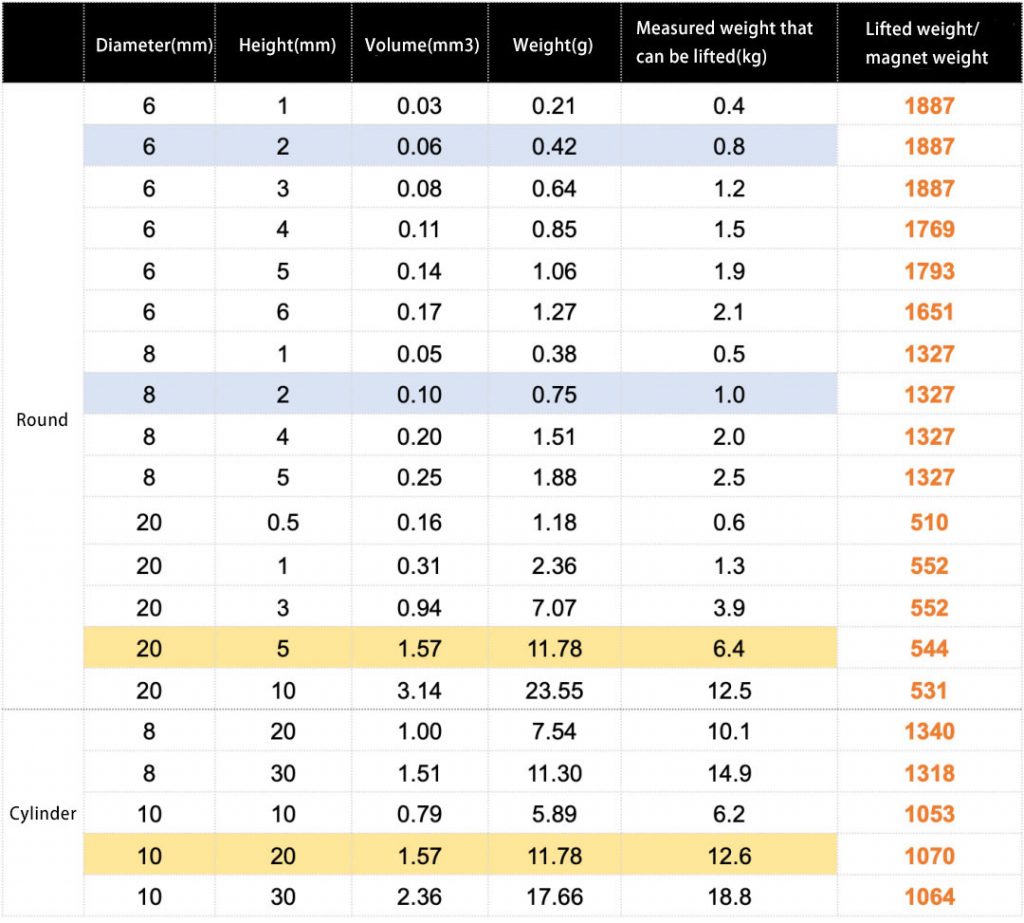
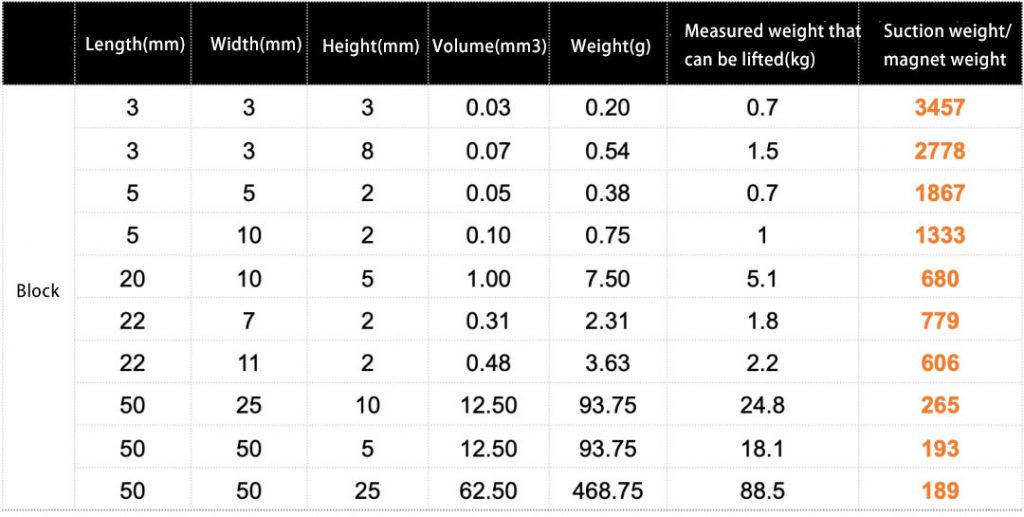
It is not difficult to find from the measurement results:
- The ratio of the weight that magnets of different shapes and sizes can absorb to their own weight varies greatly, some are less than 200 times, some are more than 500 times, and some can reach more than 3000 times, so the 600 times written on the Internet is not completely correct.
- For cylinders or round magnets with the same diameter, the greater the height, the greater the weight that can be absorbed, and the full force is basically proportional to the height.
- For cylinders or round magnets with the same height (blue cells), the greater the diameter, the greater the weight that can be absorbed, and the full force is basically proportional to the diameter.
- For cylinders or round cakes of the same volume and weight (yellow cells), the diameter and height are different, and the weight that can be absorbed varies greatly. Generally, the longer the orientation direction of the magnet, the greater the full force.
- For magnets of the same volume, the full force is not necessarily equal. Depending on the shape, the full force may vary greatly; conversely, the magnets that absorb the same weight of ferromagnetic materials may have different shapes, volumes and weights.
- Regardless of the shape, the length of the orientation direction has the greatest influence on the full force.
The above is a test of the full force of magnets of the same grade, which shows that there are many differences in the full force between different magnets of the same grade.